Right of Way at Sea: Key Rules Explained With Simple Scenarios
Right of Way at Sea: Key Rules Explained With Simple Scenarios
Right of way at sea is something many boaters feel uncertain about – and it is arguably the most common cause of dangerous situations in Norwegian waters. Who should give way? Who has the right to hold course? And what do you actually do when two boats are approaching each other?
Let us make it simple.
The Fundamental Principle: There Is No "Right of Way"
Unlike road traffic, there is no "right of way" at sea. Instead, we have give-way obligations – a duty for one party to keep clear, while the other has a duty to maintain course and speed (so the give-way vessel can calculate its maneuver).
The rules come from COLREGS (International Regulations for Preventing Collisions at Sea) and apply everywhere in Norwegian waters.
Motor vs. Sail: Who Gives Way?
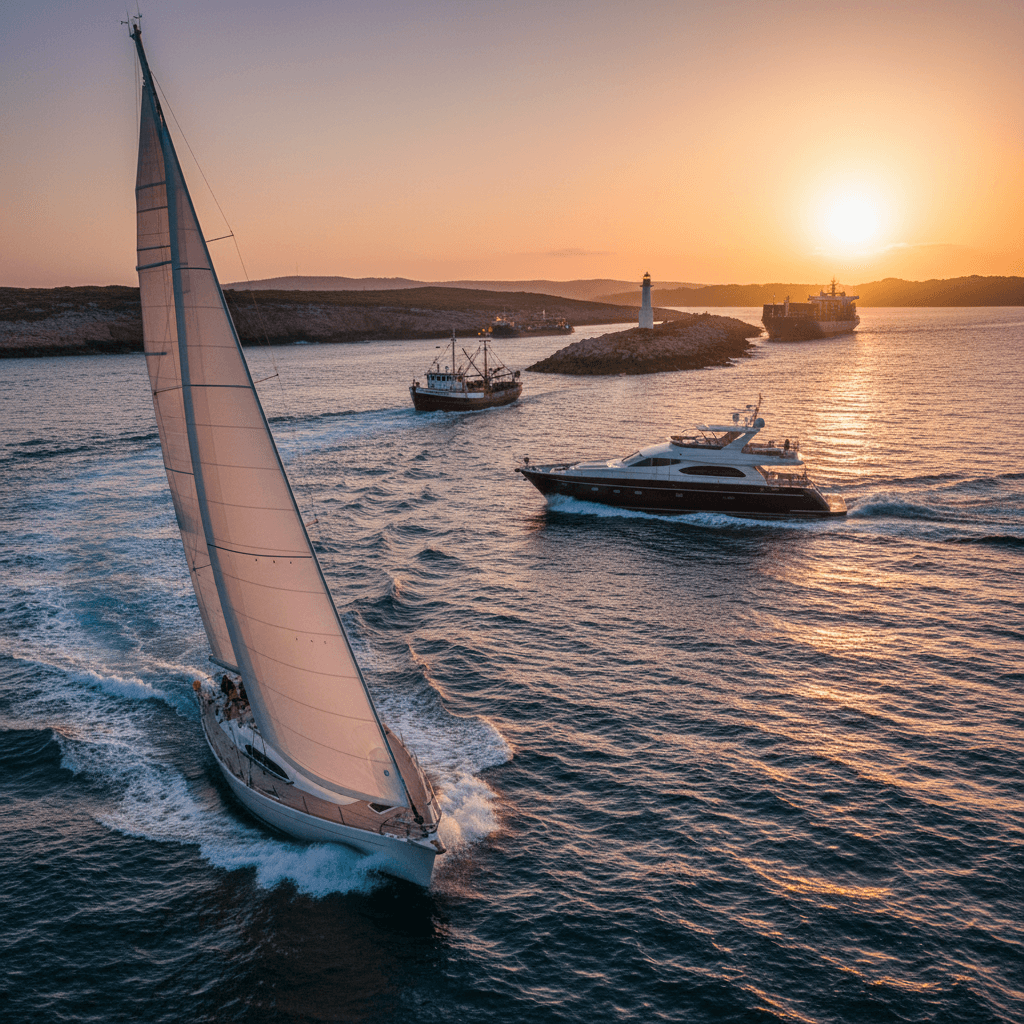
The most well-known rule: A motorboat gives way to a sailboat. A sailboat under sail (meaning without engine) generally has the right to maintain course and speed, while a motorboat must give way.
But there are important exceptions:
- A sailboat using its engine (even with sails up) is classified as a motor vessel and does not have sailing privileges
- A sailboat must not impede large ships in narrow channels and fairways
- Fishing vessels with nets or trawl have give-way privileges over both motor and sailing vessels
Sailboat vs. Sailboat
When two sailboats meet, right of way is determined by wind direction:
- The boat with wind from the port side (left) gives way to the one with wind from the starboard side (right)
- If both have wind from the same side, the windward boat gives way to the leeward boat
- Unsure which side the other boat has the wind from? You give way.
Crossing Situations (Motorboats)
When two motorboats approach each other at an angle (crossing situation), the rule is:
The boat that has the other vessel on its starboard side (right side) must give way.
Think of it as the "starboard rule" – similar to yielding to the right on roads. In practice, always keep a lookout to starboard and be ready to reduce speed or turn to starboard to pass behind the other vessel.
Head-On Meeting
When two motorboats are heading directly toward each other, both must turn to starboard (right). It is like meeting a car on a road – you keep to the right.
Recognize the situation: If you can see both sidelights (red and green) at night, or the other vessel is coming straight at you during the day, you are in a head-on situation.
Overtaking
A vessel that is overtaking another (approaching from behind) always has the give-way obligation, regardless of whether it is a motor vessel, sailboat, or kayak. You are considered to be overtaking if you approach another vessel from a sector more than 22.5 degrees abaft the beam.
In practice: If you are passing another boat, it is your responsibility to keep clear. The vessel you are passing has no obligation to move.
Narrow Channels and Fairways
In narrow straits and channels, additional rules apply:
- Keep to starboard (right side) in narrow passages
- Small boats must not impede large ships that can only navigate safely within the fairway
- Sailboats and small craft should stay out of fairways where large vessels have limited maneuverability
This is especially important in popular areas like approaches to Norwegian harbors, where large ferries and cargo ships have limited room.
Vessels With Special Privileges
Some vessels always have priority (you must always give way to them):
- Vessels not under command (engine failure, steering problems)
- Vessels restricted in ability to maneuver (diving operations, cable laying)
- Vessels constrained by draft (large tankers in shallow waters)
- Fishing vessels actively fishing (trawl or nets deployed)
- Sailing vessels (for motor vessels)
The hierarchy from least to most maneuverable: Not under command → Restricted in ability to maneuver → Constrained by draft → Fishing → Sailing → Power-driven.
Important Lights and Signals
At night, you identify other vessels by their navigation lights:
- Red light (port): You see the other vessel's left side – you likely have the give-way obligation
- Green light (starboard): You see the other vessel's right side – the other vessel normally gives way
- White stern light: You are overtaking – you have the give-way obligation
- Red + green: Head-on situation – both turn to starboard
Practical Tips
- Be predictable – The most important rule is to do what the other vessel expects. Do not turn suddenly without reason.
- Make early maneuvers – Do not wait until the last moment. A clear course change is safer than a small adjustment.
- Use your horn – One short blast (1 second) means "I am turning to starboard." Two short blasts means "I am turning to port." Five short blasts means "I do not understand your intentions."
- Keep a lookout – The single most important rule in COLREGS. Always look around, especially in faster boats.
- When in doubt, give way! – Unsure about who has the give-way obligation? Give way. It is always better to give way once too many than once too few.
Read also about speed limits at sea and the boat license for more on safe navigation. And remember: the Sea Safety Rules are an excellent complement to the right-of-way rules.